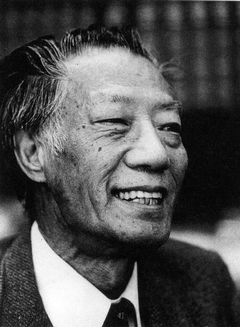
Dr. Min Chueh Chang is a Chinese American reproductive biologist. He was born on October 10, 1908, and died on June 5, 1991. He had a major impact in the field of fertilization.
He obtained a bachelor’s degree in animal psychology from Tsinghua University in Beijing. He spent a year studying agricultural science at the University of Edinburgh. He decided it was not a good fit and went on to research ram spermatozoa at Fitzwillia College, Cambridge. He became very interested in reproductive biology and immersed himself in research. In 1941, he was awarded a PhD in animal breeding by the University of Cambridge.
Shortly after moving to the United States Chang later met his wife Isabelle Chin Chang in the library at Yale University. They had two daughters and a son, who have been very successful in their individual careers.
His research and testing of the effectiveness of orally administered steroids in the control of mammalian fertility led to the invention of birth control pills. He coinvented the first birth control pill with Gregory Pincus. Although this was a huge milestone, controlling fertility was not the prime concentration of his work. His research on vitro fertilisation was arguably his greatest achievement. His work was so complex and unbelievable that many doubts were cast over the authenticity of his claim. He claimed to have achieved a successful mammal birth of in vitro fertilization of rabbit eggs. Back then, no one was able to replicate his work.
He was given many awards during his lifetime. He got the Albert Lasker Award, which was given by the Lasker Foundation and Planned Parenthood (1954.) He obtained the Ortho Medal given by the American Fertility Society (1961.) He was awarded the Wippman Scientific Research Award, given to him by the Planned Parenthood Federation of America (1987.) He also became a member of the National Academy of Sciences (1990.)